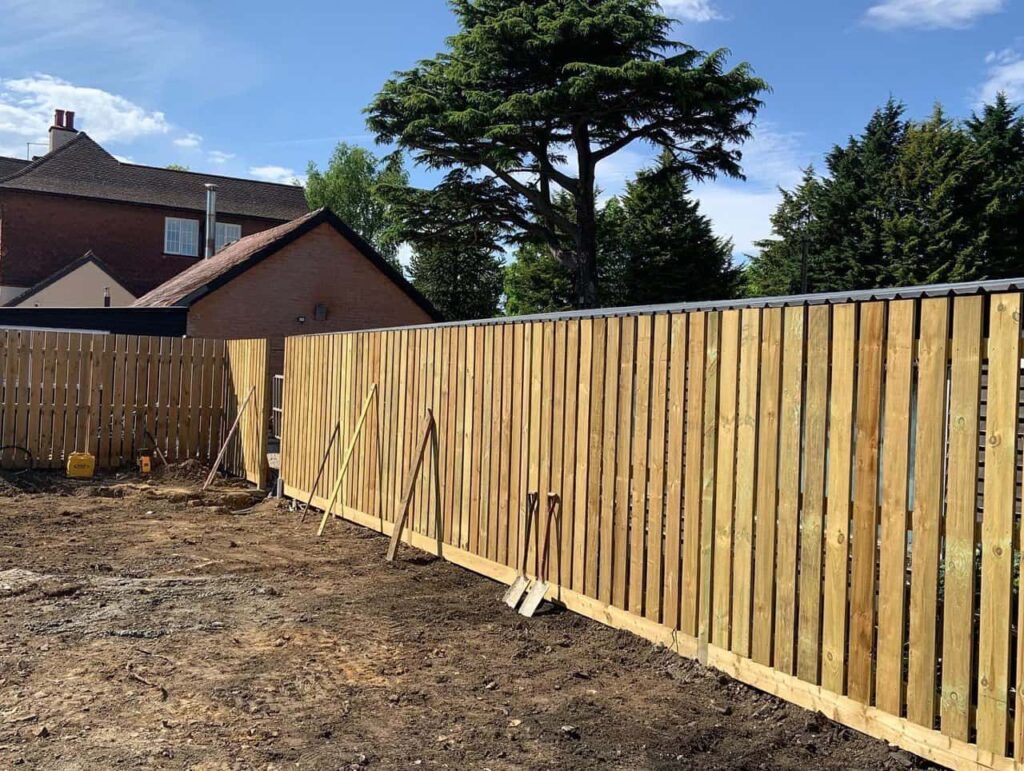
Can Damaged Feather Edge Boards Be Replaced Separately?
Feather edge fencing is popular because it creates a strong, traditional and adaptable garden boundary. Its construction also offers an important practical advantage: individual boards can often be replaced when they become damaged, without dismantling or renewing the entire fence. This makes localised repairs possible when the posts, rails and surrounding boards remain in good condition.
At Fast Fix Fencing Brandon, we provide professional fencing services throughout Brandon, Suffolk, including the assessment and repair of feather edge fencing. The key to deciding whether individual board replacement is appropriate is understanding whether the damage is confined to the boards themselves or is part of a wider problem affecting the fence structure.
How Feather Edge Fencing Is Constructed
Unlike a pre-assembled fence panel, traditional feather edge fencing is generally built on site from individual components.
The main structure typically consists of:
- Fence posts
- Horizontal rails
- Individual overlapping feather edge boards
- Supporting and finishing components
Because the vertical boards are fitted individually, a damaged board can often be removed and replaced while leaving neighbouring boards and the supporting structure in place.
When Can a Single Feather Edge Board Be Replaced?
Individual replacement is usually practical when damage is genuinely localised.
For example, one or several boards may have:
- Split
- Cracked
- Warped significantly
- Become loose
- Sustained impact damage
- Developed isolated deterioration
If the surrounding boards remain serviceable and the fence structure is stable, replacing only the affected pieces can restore the boundary without unnecessary wider work.
The Supporting Rails Need to Be Checked
Before replacing a damaged board, it is important to inspect what it is attached to.
Feather edge boards rely on horizontal rails for support. If these rails are sound, fitting a replacement board is relatively straightforward for an experienced fencing professional.
If the rails have deteriorated, however, simply attaching a new board to weakened timber will not resolve the underlying problem.
This is why a proper fencing repair should consider more than the component that is visibly damaged.
Fence Posts Are Equally Important
Posts provide the main structural support for the entire fence.
If a fence is leaning, moving excessively or becoming unstable, replacing a few feather edge boards will not correct the fundamental issue if the posts are responsible.
Signs that the posts may require attention include:
- Noticeable leaning
- Movement when the fence is under light pressure
- Deterioration around the lower sections
- Sections of fencing no longer remaining aligned
Where posts and rails remain secure, individual board replacement becomes a much more practical repair.
Why Do Feather Edge Boards Become Damaged?
Understanding the cause of the damage can help determine whether replacing individual boards is likely to provide a lasting result.
Boards may deteriorate because of:
- Long-term weather exposure
- Strong winds
- Accidental impact
- Movement within the fence
- Moisture-related timber deterioration
- Natural ageing
- Loose or unsuitable fixings
If several boards have failed for the same reason, the surrounding fence should be checked before repairs are completed.
What If Several Adjacent Boards Are Damaged?
A repair does not have to be limited to one board.
If several neighbouring boards have deteriorated but the supporting framework remains sound, that section can often be renewed independently. The damaged boards can be removed and suitable replacements installed while retaining the rest of the fence.
This targeted approach is one of the useful characteristics of feather edge construction.
Matching Replacement Boards Correctly
A successful repair should not only restore strength; it should also maintain the consistent appearance of the fence.
Replacement boards need to be appropriately sized, positioned and overlapped. Correct overlap is particularly important because it contributes to privacy and helps create the characteristic continuous appearance of feather edge fencing.
New timber may initially look different from older weathered boards, but it will naturally change in appearance as it is exposed to outdoor conditions.
Correct Fixing Matters
Simply placing a new board into the gap is not enough.
The replacement needs to be securely attached while maintaining the correct alignment and overlap with neighbouring boards. Poor positioning can create uneven gaps or affect the visual consistency of the fence.
Professional installation ensures the replacement integrates properly with the existing section rather than appearing as an awkward addition.
When Individual Replacement May Not Be Enough
There are situations where replacing separate boards would only address the visible symptoms.
More extensive fencing work may be appropriate where:
- Large numbers of boards are deteriorating
- Supporting rails are weakened
- Posts have become unstable
- The fence is leaning significantly
- Several sections are approaching the end of their serviceable condition
- Previous repairs are repeatedly failing
In these circumstances, the fence should be assessed as a complete structure before deciding how much needs to be renewed.
Why Localised Repairs Can Help Extend Fence Life
A small defect does not necessarily mean a complete fence has stopped performing effectively.
Addressing damaged boards promptly can prevent gaps from developing and help maintain the strength, privacy and appearance of the boundary. It also provides an opportunity to inspect the surrounding section for early signs of deterioration.
Regular attention to localised problems can therefore form an important part of maintaining feather edge fencing over the longer term.
Professional Assessment Avoids Unnecessary Replacement
From a distance, several broken boards can sometimes make a fence appear to be in worse condition than it really is.
At Fast Fix Fencing Brandon, we assess feather edge fencing throughout Brandon, Suffolk, to determine which components are actually causing the problem. If the posts and rails remain strong, replacing damaged boards may be all that is required. If structural components have deteriorated, those issues can be identified rather than hidden behind new timber.
The objective is to carry out work that genuinely improves the condition of the fence.
Keeping Feather Edge Fencing in Good Condition
Routine visual checks can help homeowners identify problems while they are still relatively localised.
It is worth looking periodically for:
- Loose boards
- Splitting timber
- Movement around posts
- Damaged rails
- Changes in fence alignment
- Sections affected by vegetation or impact
Early attention can often make repairs more straightforward and help prevent deterioration from spreading into neighbouring sections.
Conclusion
Yes, damaged feather edge boards can often be replaced separately. Because feather edge fencing is constructed using individual overlapping boards, isolated damage does not automatically mean the complete fence needs renewing. Where the posts, rails and surrounding timber remain sound, individual or small groups of boards can usually be replaced to restore the appearance and function of the boundary.
However, it is important to establish why the boards have become damaged. If weakened posts, deteriorated rails or wider structural movement are responsible, replacing the boards alone will not provide a complete solution.
If your feather edge fencing in Brandon, Suffolk, has damaged, loose or deteriorated boards, Fast Fix Fencing Brandon can assess the affected section and recommend an appropriate repair. Contact our team to discuss professional fencing repairs designed to restore your boundary without replacing sound components unnecessarily.
Call us on: 01842 771 493
Click here to find out more about Fast Fix Fencing Brandon
Click here to complete our contact formand see how we can help with your fencing needs.